

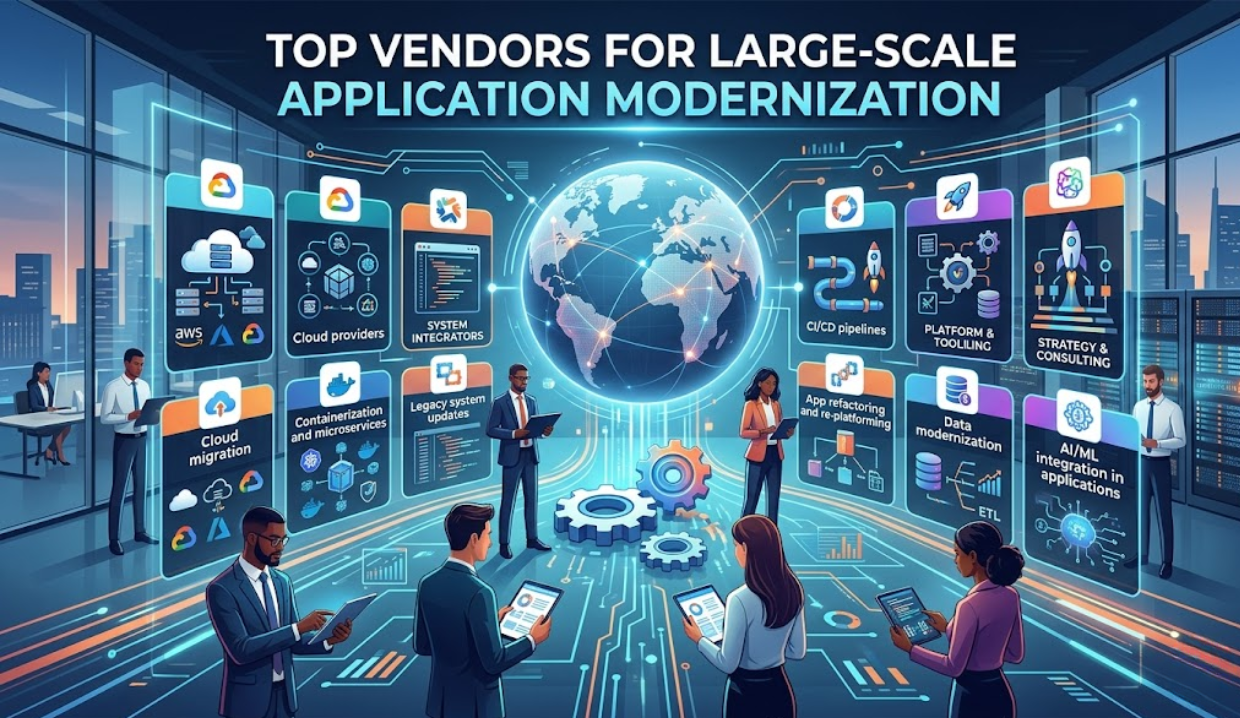
Modern enterprises are under constant pressure to innovate—but many are still running on decades-old systems. These legacy platforms slow down development, increase costs, and limit scalability. That’s where large-scale application modernization vendors come in.
They help organizations transform outdated systems into agile, cloud-native architectures without disrupting operations. But choosing the right partner—and understanding how modernization actually works—is where most businesses struggle.
This guide breaks it all down. You’ll learn what application modernization really means, how top vendors operate, how to evaluate them, and what risks to watch out for.
What Large-Scale Application Modernization Really Means
Application modernization is the process of upgrading legacy software systems to modern architectures, often involving cloud adoption, microservices, and DevOps practices.
At enterprise scale, this isn’t a simple upgrade—it’s a multi-phase transformation involving hundreds of applications, complex dependencies, and critical business functions.
Key Modernization Approaches
Most vendors use a mix of these strategies:
- Rehosting (Lift and Shift): Move applications to the cloud with minimal changes
- Replatforming: Optimize applications for cloud environments
- Refactoring: Modify code for better performance and scalability
- Rearchitecting: Redesign applications into microservices
- Rebuilding/Replacing: Create entirely new systems
Each approach depends on business goals, technical debt, and system complexity.
When Enterprises Need Modernization at Scale
Organizations typically consider modernization when:
- Legacy systems become expensive to maintain
- Innovation cycles slow down
- Security vulnerabilities increase
- Integration with modern tools becomes difficult
- Customer expectations outgrow system capabilities
How to Evaluate Top Modernization Vendors
Choosing the right enterprise application modernization vendor requires more than checking brand names. You need a structured evaluation.
1. Vendor Capability Maturity
Look for vendors that offer:
- End-to-end modernization (assessment → execution → optimization)
- Proven experience in large-scale transformations
- Strong governance and delivery frameworks
Companies like Accenture and IBM often lead in maturity due to their enterprise-scale experience.
Also read: How to Use Lightniteone New Version on PC for Best Performance
2. Technical Expertise
Top vendors specialize in:
- Cloud platforms like Amazon Web Services, Microsoft Azure, and Google Cloud Platform
- Containerization tools such as Docker
- Orchestration systems like Kubernetes
They also integrate DevOps pipelines using tools like Terraform and Ansible.
3. Industry-Specific Experience
Modernization in banking is very different from healthcare or retail. Vendors must understand:
- Compliance requirements
- Data sensitivity
- Industry-specific workflows
Firms like Cognizant and Infosys often specialize in vertical-specific solutions.
4. Vendor Lock-In Risk
A critical but overlooked factor. Evaluate:
- Multi-cloud compatibility
- Open-source adoption
- Exit strategies
Avoid vendors that tightly bind your systems to proprietary ecosystems.
5. SLA and Performance Benchmarks
Strong vendors define:
- Uptime guarantees
- Performance targets
- Migration timelines
These benchmarks are essential for mission-critical systems.
Top Enterprise Vendors for Application Modernization
The market includes a mix of global consulting giants and specialized firms.
Global Consulting Leaders
- Accenture
- Deloitte
- Capgemini
These vendors provide end-to-end transformation services, including strategy, execution, and governance.
IT Services and Transformation Specialists
- Tata Consultancy Services
- Wipro
- Infosys
They excel in large-scale delivery and cost-efficient execution.
Cloud-Native and Niche Vendors
These focus on:
- Microservices transformation
- API-led modernization
- Kubernetes migration
They are often more agile and specialized compared to larger firms.
Modernization Approaches Used by Leading Vendors
Rehosting vs Refactoring vs Rearchitecting
| Approach | Complexity | Cost | Scalability | Use Case |
|---|---|---|---|---|
| Rehosting | Low | Low | Limited | Quick cloud migration |
| Refactoring | Medium | Medium | High | Performance improvement |
| Rearchitecting | High | High | Very High | Full digital transformation |
Containerization and Orchestration
Modern vendors rely on containerization to:
- Improve scalability
- Enable faster deployments
- Simplify environment consistency
Tools like Docker and Kubernetes play a central role.
API-First and Event-Driven Models
Modern systems are built using:
- API-led architectures
- Event-driven communication
This allows seamless integration with platforms like Salesforce, SAP, and Oracle.
AI-Assisted Modernization
Emerging vendors now use AI to:
- Analyze legacy code
- Suggest refactoring strategies
- Automate testing and deployment
Cost, Timeline, and ROI of Large-Scale Modernization
Cost Breakdown
Typical cost components include:
- Assessment and planning
- Infrastructure migration
- Code transformation
- Testing and validation
- Post-migration optimization
Hidden Costs Enterprises Overlook
- Downtime risks
- Data migration errors
- Vendor coordination overhead
- Training and change management
ROI Measurement Framework
To measure success, track:
- Reduced infrastructure costs
- Faster deployment cycles
- Improved system performance
- Enhanced customer experience
Risks and Challenges in Vendor-Led Modernization
Data Migration Risks
Moving large datasets can lead to:
- Data loss
- Corruption
- Compliance issues
Downtime and Business Continuity
Mission-critical systems require:
- Zero-downtime strategies
- Phased migration approaches
Security and Compliance
Modernization introduces new vulnerabilities if not handled properly. Vendors must ensure:
- Secure cloud configurations
- Compliance with regulations
Multi-Vendor Complexity
Large enterprises often work with multiple vendors, leading to:
- Coordination challenges
- Integration issues
- Accountability gaps
Best Practices for Managing Modernization Vendors
Governance Framework
Establish:
- Clear roles and responsibilities
- Regular performance reviews
- Defined escalation processes
Communication Structure
Ensure:
- Transparent reporting
- Frequent updates
- Alignment between business and technical teams
Change Management
Modernization impacts people as much as technology. Focus on:
- Employee training
- Stakeholder alignment
- Adoption strategies
Enterprise Use Cases and Real-World Scenarios
Banking and Financial Systems
Banks modernize to:
- Improve transaction speed
- Enhance security
- Meet regulatory requirements
Healthcare Systems
Hospitals upgrade systems to:
- Ensure patient data security
- Improve interoperability
- Enable real-time analytics
Retail and eCommerce
Retailers modernize to:
- Handle peak traffic
- Personalize customer experiences
- Integrate omnichannel platforms
Future Trends in Application Modernization Vendors
AI-Driven Code Transformation
AI tools will increasingly:
- Automate legacy code analysis
- Suggest optimal architectures
Serverless Modernization
Serverless platforms reduce:
- Infrastructure management
- Operational costs
Autonomous Cloud Operations
Future systems will:
- Self-optimize performance
- Automatically scale resources
How to Choose the Right Vendor: Step-by-Step
- Define your modernization goals
- Assess your application portfolio
- Shortlist vendors based on expertise
- Evaluate technical capabilities and tools
- Analyze cost and ROI projections
- Check case studies and references
- Conduct a pilot project before full rollout
FAQS: Top vendors for large-scale application modernization
Who are the best vendors for large-scale application modernization?
Top vendors include global consulting firms, IT service providers, and niche specialists. The best choice depends on your industry, scale, and technical requirements.
How long does enterprise modernization take?
It can range from months to several years, depending on system complexity, number of applications, and chosen strategy.
Should enterprises outsource modernization?
Outsourcing provides expertise and scalability, but requires strong governance to avoid vendor dependency.
What technologies do modernization vendors use?
They rely on cloud platforms, containerization, microservices, DevOps pipelines, and automation tools.
Final Takeaways
Large-scale application modernization is not just a technical upgrade—it’s a strategic transformation. The right vendor can accelerate innovation, reduce costs, and future-proof your business.
Before choosing a partner:
- Focus on long-term scalability, not short-term savings
- Prioritize flexibility to avoid vendor lock-in
- Evaluate both technical and business alignment
- Plan for risks, not just outcomes
Done right, modernization becomes a competitive advantage—not just an IT project
