

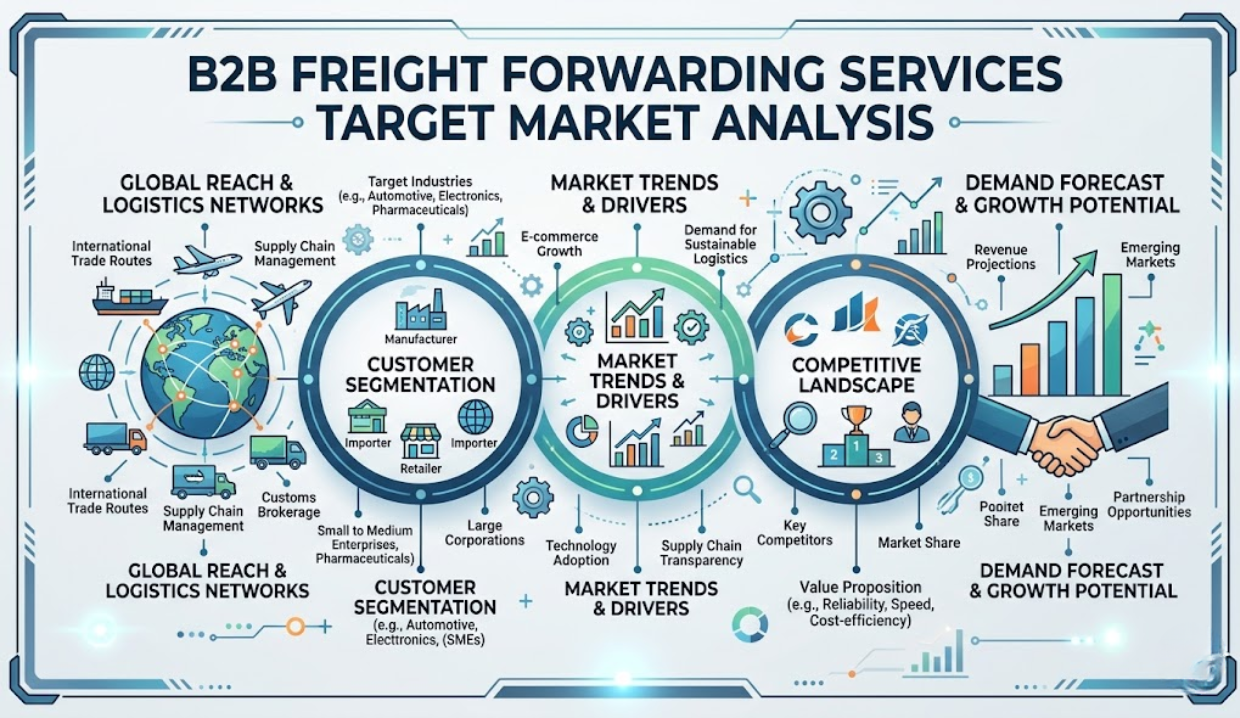
Understanding who your ideal customers are in freight forwarding is no longer optional—it’s the difference between predictable growth and wasted effort. Many logistics companies struggle because they chase broad markets instead of focusing on high-value segments that actually convert.
A b2b freight forwarding services target market analysis solves this by identifying the right industries, behaviors, and demand signals. It helps you attract better clients, improve margins, and build long-term contracts instead of relying on inconsistent shipments.
This guide breaks down the full landscape—from basic segmentation to advanced, data-driven strategies—so you can build a smarter, more profitable freight forwarding business.
Understanding the Freight Forwarding Market Landscape
What Is a Target Market in Freight Forwarding?
A target market in freight forwarding refers to a clearly defined group of businesses that require logistics services based on shared characteristics such as industry, shipment volume, trade routes, or cargo type.
In simple terms, instead of serving “everyone who ships goods,” you focus on specific customer segments where your services create the most value.
Market Structure and Key Segments
The freight forwarding ecosystem includes multiple layers:
- Small and medium exporters (SMEs)
- Large enterprise supply chains
- Import-heavy distributors
- Cross-border eCommerce businesses
- Specialized industries like pharma or heavy machinery
Each group behaves differently in terms of pricing sensitivity, shipment frequency, and service expectations.
Role of Global Trade and Supply Chains
Global trade dynamics shape demand. Trade lanes such as Asia–Europe or Trans-Pacific routes influence:
- Shipping costs
- Delivery timelines
- Regulatory complexity
Businesses operating across these corridors often require tailored freight solutions, making trade lane analysis a core part of segmentation.
Defining the Ideal Customer Profile (ICP)
A strong freight forwarding ICP (ideal customer profile) helps you filter out low-value leads and focus on profitable clients.
Business Size and Shipment Volume
Segment clients based on volume:
- Low volume: occasional shipments, price-sensitive
- Mid volume: consistent shipping, balanced priorities
- High volume: contract-based, value reliability over cost
High-volume clients typically offer better lifetime value and predictable revenue.
Industry-Specific Needs
Different industries have unique logistics requirements:
| Industry | Key Need | Complexity Level |
|---|---|---|
| Manufacturing | Bulk shipping, cost efficiency | Medium |
| Pharma | Cold chain logistics | High |
| Retail | Speed and flexibility | Medium |
| Heavy Equipment | Oversized cargo handling | High |
This is where industry vertical targeting becomes critical.
Geographic Trade Lane Focus
Not all regions are equal. A shipping route-based customer targeting strategy helps identify profitable corridors.
Example:
- Asia to Europe: high volume, competitive pricing
- Middle East to Africa: emerging opportunity, less competition
Also read: How Does B2B Intent Data News Impact Sales Marketing Strategies
Advanced Customer Segmentation Strategies
Industry-Based Segmentation
Start with industries that rely heavily on international trade:
- Export manufacturers
- Automotive supply chains
- Fashion and apparel brands
- Amazon FBA exporters
Each represents a distinct logistics service demand cluster.
Cargo and Shipment Type Segmentation
Cargo type influences operational complexity:
- Perishable goods (cold chain logistics systems)
- Hazardous materials (compliance-heavy)
- Bulk cargo (cost optimization focus)
- Oversized cargo (project logistics)
This is known as cargo type-based market segmentation.
Behavioral and Intent-Based Segmentation
Beyond demographics, analyze behavior:
- Shipment frequency
- Urgency levels
- Decision-making speed
Logistics buyer intent signals include:
- Frequent RFQs (requests for quotes)
- Switching providers
- Expanding into new markets
Digital Maturity and Tech Adoption
Modern clients often use:
- Transportation Management Systems (TMS)
- Freight Management Systems (FMS)
- EDI (Electronic Data Interchange)
Companies with higher digital maturity expect real-time tracking, automation, and data transparency.
Buyer Decision Dynamics in Freight Forwarding
Key Decision Makers and Influencers
B2B freight decisions involve multiple roles:
- Procurement managers (cost-focused)
- Operations managers (efficiency-focused)
- Supply chain heads (strategy-focused)
Understanding this decision-making unit is essential.
Procurement Cycles and Buying Triggers
Freight contracts are often tied to:
- Seasonal demand spikes
- Supplier changes
- Market expansion
Typical triggers include:
- Rising shipping costs
- Service failures
- New trade routes
Pricing Sensitivity and Contract Preferences
Clients fall into two main groups:
- Spot buyers: prioritize lowest price
- Contract clients: prioritize reliability and consistency
A freight forwarding pricing sensitivity analysis helps tailor offers accordingly.
High-Value Target Markets to Focus On
Manufacturing and Industrial Exporters
These businesses ship in bulk and require cost-efficient solutions. They value:
- Predictable transit times
- Competitive rates
- Long-term contracts
eCommerce and Cross-Border Retail
Fast-growing segment with unique needs:
- Small but frequent shipments
- Fast delivery cycles
- Integration with marketplaces
Pharma and Cold Chain Logistics
Highly regulated segment requiring:
- Temperature-controlled shipping
- Strict compliance
- Real-time monitoring
Heavy Equipment and Project Cargo
This niche involves:
- Oversized shipments
- Custom handling
- Route planning
It’s less competitive but highly specialized.
Pain Points and Needs by Customer Segment
Cost Efficiency and Hidden Charges
Many clients struggle with:
- Unpredictable surcharges
- Lack of pricing transparency
Addressing hidden cost sensitivity builds trust.
Delivery Reliability and Speed
Late shipments disrupt entire supply chains. High-value clients prioritize:
- On-time delivery (OTIF metrics)
- Consistent transit times
Compliance and Documentation Challenges
International shipping involves:
- HS Code classification
- Customs brokerage processes
- Trade compliance regulations
Errors can lead to delays and penalties.
Competitive Positioning by Target Market
Service Differentiation Strategies
To stand out, align services with segment needs:
- Pharma: compliance expertise
- eCommerce: speed and flexibility
- Manufacturing: cost optimization
Niche Specialization Opportunities
Untapped niches include:
- Amazon FBA exporters
- Cold chain logistics for biotech
- Heavy machinery exporters
These markets often have less competition and higher margins.
Trade Lane Optimization
Focus on specific routes where you can build:
- Strong carrier relationships
- Better pricing
- Faster delivery
Data-Driven Market Analysis Framework
Demand Forecasting by Industry
Use historical data to predict:
- Shipment volumes
- Seasonal demand
- Growth trends
This supports logistics service demand forecasting by the industry.
Customer Lifetime Value Analysis
Not all clients are equal. Evaluate:
- Revenue per client
- Retention rate
- Cost to serve
This helps prioritize high-value segments.
Profitability by Segment
Analyze:
- Margins per shipment
- Operational costs
- Risk exposure
This leads to better freight forwarding margin optimization by segment.
Untapped Opportunities in Freight Forwarding Markets
Emerging Trade Corridors
New routes often offer:
- Less competition
- Higher margins
Example: developing markets in Africa or Southeast Asia.
Under-Served Niches
Look for gaps such as:
- Small exporters needing scalable solutions
- Businesses lacking digital logistics tools
Digital Transformation Gaps
Many companies still rely on manual processes. Offering:
- Real-time tracking
- Automated workflows
- CRM-integrated logistics
can be a strong differentiator.
How to Build a Target Market Strategy That Converts
Step 1: Identify High-Value Segments
Focus on:
- High shipment frequency
- Long-term contract potential
- Low churn risk
Step 2: Create Segment-Specific Value Propositions
Tailor messaging based on:
- Industry needs
- Pain points
- Buying behavior
Step 3: Build a Segmented Sales Funnel
Use a freight forwarding sales funnel segmentation approach:
- Awareness: educational content
- Consideration: case studies
- Decision: pricing and proposals
Step 4: Optimize Lead Qualification
Filter leads using:
- Shipment volume
- Trade routes
- Budget
This improves conversion rates.
Step 5: Focus on Retention and Expansion
Retention strategies include:
- Consistent service quality
- Transparent pricing
- Strong communication
FAQS: B2B Freight Forwarding Services Target Market Analysis
How to identify the target market for freight forwarding services?
Start by analyzing industries with high shipping demand, then segment them by shipment volume, cargo type, and trade routes. Combine this with behavioral data like shipment frequency and buying intent.
What industries use freight forwarding the most?
Manufacturing, retail, e-commerce, pharmaceuticals, and heavy equipment sectors are among the largest users due to their reliance on global supply chains.
What factors influence freight forwarding buying decisions?
Key factors include pricing, reliability, transit time, compliance expertise, and service transparency.
How to build a freight forwarding ideal customer profile?
Define your ICP using:
Industry type
Shipment volume
Geographic routes
Budget and pricing sensitivity
What is the best niche in the freight forwarding business?
High-value niches include cold chain logistics, Amazon FBA exporters, and project cargo due to their specialized requirements and lower competition.
Conclusion: Turning Analysis Into Growth
A well-executed b2b freight forwarding services target market analysis transforms how you acquire and retain clients. Instead of competing on price alone, you position your business where demand, profitability, and expertise align.
Key takeaways:
- Focus on segmentation, not mass targeting
- Prioritize high-value industries and trade lanes
- Use data to guide decisions, not assumptions
- Specialize in niches where competition is low
- Align services with real customer pain points
When done right, target market analysis doesn’t just improve marketing—it reshapes your entire business strategy for long-term success.
