

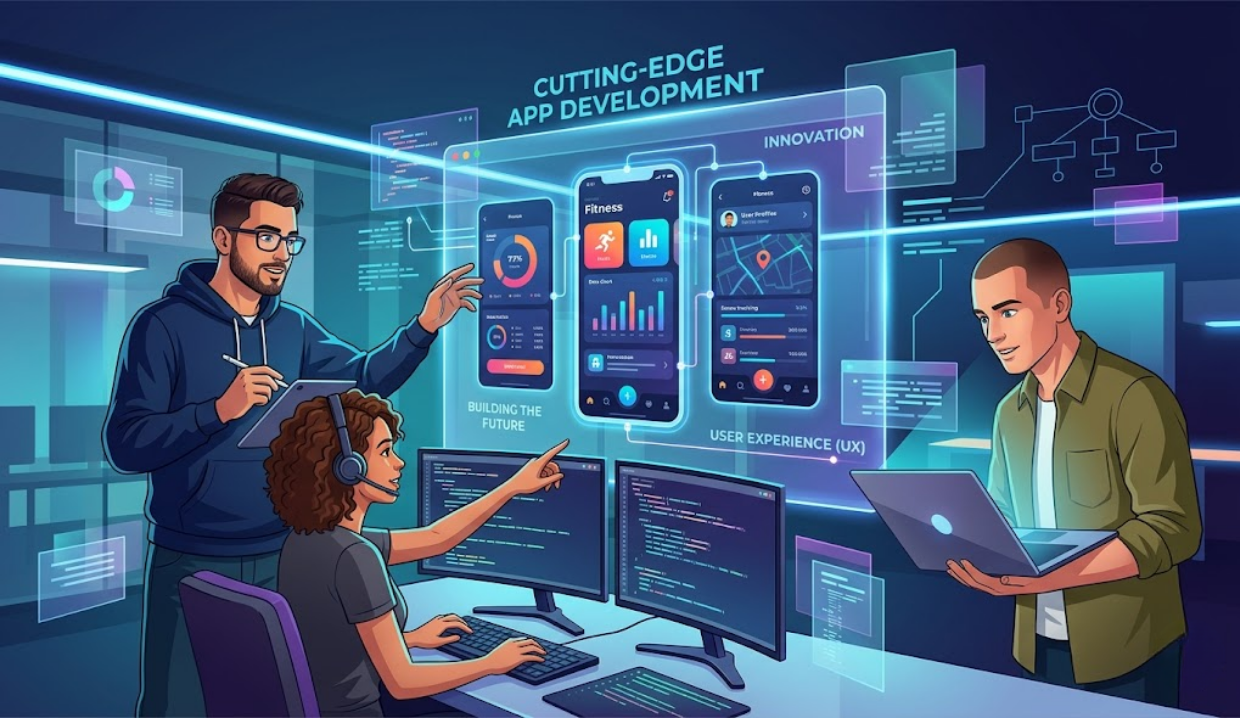
Modern users expect apps to be fast, intelligent, secure, and always available. Traditional development approaches struggle to meet these expectations at scale. That’s where cutting edge app development steps in—combining advanced architectures, real-time processing, and intelligent systems to build future-ready applications.
This guide breaks down what truly defines next-gen app development, the technologies behind it, and how to implement it effectively.
What Defines Cutting Edge App Development
Cutting edge app development refers to building applications using modern architectures, intelligent systems, and scalable infrastructure that deliver high performance, real-time experiences, and adaptive user interfaces.
It goes beyond simply building an app—it focuses on creating systems that evolve, learn, and scale seamlessly.
Key Characteristics of Next-Gen Apps
- Adaptive UI rendering systems that adjust based on user behavior
- Real-time app state synchronization across devices
- Low-latency app performance engineering for instant responses
- Privacy-first app engineering built into the core
- Context-aware mobile interfaces that react dynamically
In simple terms, these apps don’t just respond—they anticipate.
Core Technologies Powering Modern Apps
AI and Machine Learning Integration
AI-assisted app development workflows are transforming how apps are built and experienced. From intelligent UX personalization engines to autonomous debugging systems, AI is embedded across the lifecycle.
Examples include:
- Recommendation systems adapting in real time
- Predictive performance scaling in apps
- Emotion-aware user interface design
Frameworks like TensorFlow Lite allow developers to integrate machine learning directly into mobile apps.
Edge Computing and Real-Time Processing
Edge computing in mobile apps reduces latency by processing data closer to the user instead of relying entirely on centralized servers.
Benefits:
- Faster response times
- Reduced bandwidth usage
- Improved reliability
This is especially useful for apps requiring real-time data processing and synchronization, such as live tracking or gaming platforms.
WebAssembly and Advanced Runtime Environments
WebAssembly (Wasm) enables near-native performance in web and mobile environments. It plays a key role in cross-platform runtime optimization and supports complex applications like video editing or gaming directly in the browser.
Advanced Architecture Patterns
Microservices, Serverless, and Cloud-Native Systems
Modern apps rely on cloud-native app engineering and serverless mobile backends to scale efficiently.
| Architecture Type | Key Benefit | Use Case |
|---|---|---|
| Microservices | Flexibility and scalability | Large-scale apps |
| Serverless | Cost efficiency and auto-scaling | Event-driven apps |
| Monolithic | Simplicity | Small apps |
Tools like AWS Lambda and Kubernetes support containerized mobile environments and distributed systems.
Event-Driven and Reactive Systems
Event-driven mobile frameworks and reactive programming in apps allow systems to respond instantly to user actions or data changes.
This enables:
- Real-time notifications
- Live data updates
- Seamless user interactions
Technologies like Apache Kafka and Redis support event-sourced mobile data architectures.
Also read: Best Real-Time Payout Solutions For Rewards And Incentives
API-First and Headless Architecture
An API-first app architecture ensures every feature is accessible via APIs, enabling flexibility across platforms.
A headless app development approach separates frontend and backend, allowing:
- Faster updates
- Omnichannel experiences
- Scalable frontend microservices
Performance Engineering at Scale
Low-Latency Optimization Techniques
Speed is critical. Advanced apps use:
- Intelligent caching (Redis)
- CDN-based edge networks
- Adaptive bandwidth consumption apps
But performance isn’t just about speed—it’s also about perception. App latency perception optimization ensures users feel the app is fast, even under load.
Offline-First and Synchronization
Offline-first app synchronization ensures apps work even without internet connectivity.
Key elements:
- Local data storage
- Background sync
- Conflict resolution strategies
This is essential for global apps where connectivity varies.
Continuous Deployment and Zero Downtime
Modern pipelines use continuous deployment pipelines for apps to push updates without disruption.
Best practices:
- Automate testing
- Use feature flags
- Enable zero-downtime app releases
UX Innovation in Cutting Edge Apps
AI-Powered Personalization
Apps now use hyper-personalization using behavioral AI to tailor experiences in real time.
Examples:
- Personalized content feeds
- Dynamic recommendations
- Intent-driven navigation systems
Invisible and Adaptive UX Patterns
Invisible UX design patterns remove friction by anticipating user needs.
Examples include:
- Autofill suggestions
- Smart notifications
- Context-aware actions
These are powered by AI-driven UI adaptation in real time.
Multimodal and Ambient Experiences
Modern apps support multimodal interaction (voice, gesture, touch) and ambient computing app experiences.
Think of apps that:
- Respond to voice commands
- Adapt to surroundings
- Integrate seamlessly with IoT devices
Security and Privacy Frameworks
Zero Trust Architecture
Zero Trust Security frameworks ensure no user or system is trusted by default.
Core principles:
- Continuous verification
- Least privilege access
- Strong authentication (OAuth 2.0)
Privacy-by-Design Implementation
Privacy-by-design mobile frameworks integrate data protection from the start.
This includes:
- Data minimization
- Encryption
- Transparent user controls
Decentralized Identity and Security
Decentralized identity integration in apps allows users to control their data without relying on centralized systems.
This is especially relevant for blockchain-based and decentralized apps (dApps).
DevOps and Deployment Evolution
CI/CD and Automation
Modern development relies on CI/CD tools like GitHub Actions and Jenkins pipelines.
These enable:
- Faster releases
- Automated testing
- Continuous improvement
Observability and Monitoring
App observability and monitoring systems track performance, errors, and user behavior in real time.
This helps teams:
- Detect issues early
- Optimize performance
- Improve user experience
Emerging Trends and Future Directions
Autonomous and Self-Healing Apps
Self-healing mobile applications can detect and fix issues automatically without human intervention.
Combined with autonomous app optimization systems, apps can:
- Adjust performance dynamically
- Fix bugs in real time
- Improve continuously
Decentralized and Blockchain Apps
Decentralized apps (dApps) use blockchain to create transparent and secure systems.
Use cases:
- Finance (DeFi)
- Identity management
- Supply chain tracking
Neural and Future-Ready Interfaces
Emerging innovations include:
- Neural interface-ready app concepts
- Digital twin integration in mobile apps
- Quantum-ready app infrastructure concepts
These are shaping the next decade of app development.
How to Build a Cutting Edge App Step-by-Step
1. Choose the Right Tech Stack
Select tools based on scalability and performance:
- Flutter or React Native for frontend
- Node.js or serverless environments for backend
- GraphQL for efficient APIs
2. Design Scalable Architecture
Focus on:
- Microservices or serverless architecture
- Distributed app data layers
- Modular app design systems
3. Implement Core Features
Include:
- Real-time synchronization
- AI-driven personalization
- Offline-first capabilities
4. Optimize Performance
Use:
- Edge computing
- Intelligent caching
- Cross-platform runtime optimization
5. Ensure Security and Compliance
Apply:
- Zero Trust models
- Encryption standards
- Privacy-first principles
6. Deploy and Continuously Improve
- Use CI/CD pipelines
- Monitor app performance
- Implement dynamic feature delivery systems
Common Mistakes and Strategic Insights
Overengineering vs Practical Innovation
Using cutting-edge technology doesn’t mean using everything. Focus on solving real problems instead of adding unnecessary complexity.
Ignoring User Experience
Even the most advanced system fails if the UX is poor. Prioritize:
- Simplicity
- Speed
- Accessibility
Lack of Scalability Planning
Without proper architecture, apps struggle with growth. Always design for scale from day one.
FAQS: Cutting edge app development
What is cutting edge app development?
It is the use of modern technologies, architectures, and intelligent systems to build scalable, high-performance, and adaptive applications that meet evolving user expectations.
How is AI transforming app development workflows?
AI automates testing, debugging, and personalization. It enables predictive insights, real-time adaptation, and smarter user experiences.
What is the best architecture for scalable mobile apps?
Microservices and serverless architectures are ideal due to their flexibility, scalability, and ability to handle distributed workloads.
How do edge computing apps improve performance?
By processing data closer to users, edge computing reduces latency and improves real-time responsiveness.
What are composable applications?
Composable app ecosystems allow developers to build apps using interchangeable components, making systems more flexible and scalable.
Final Thoughts: Building Future-Proof Applications
Cutting edge app development is not about chasing trends—it’s about building systems that adapt, scale, and evolve.
Key takeaways:
- Focus on scalable, cloud-native architectures
- Use AI for personalization and automation
- Prioritize performance, security, and UX equally
- Embrace emerging technologies strategically
The future belongs to apps that are intelligent, resilient, and user-centric. Building with these principles ensures your application stays relevant in an ever-changing digital landscape.
