

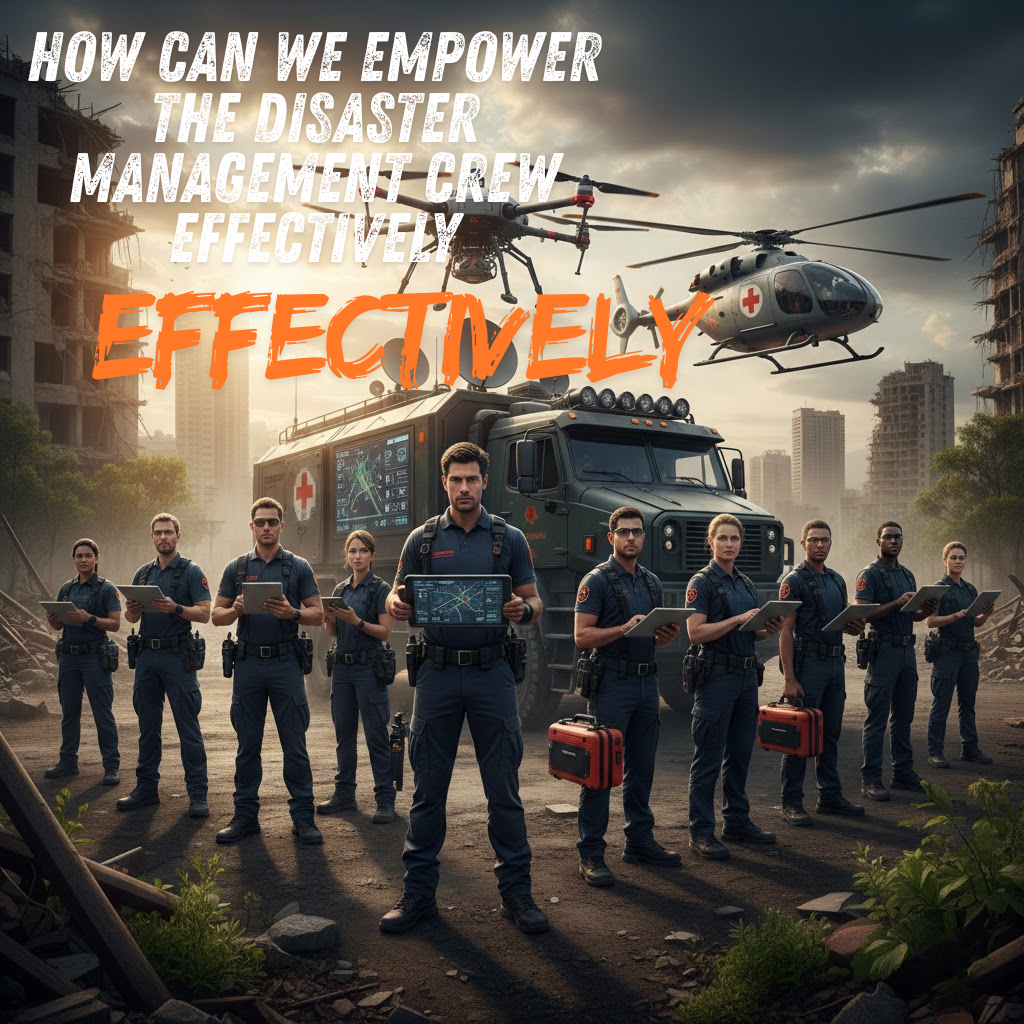
Disasters rarely fail because of a lack of intent. They fail because the people on the ground are constrained by systems, communication gaps, limited authority, fatigue, or outdated processes. When floods rise, earthquakes strike, or wildfires spread, the disaster management crew becomes the most critical asset in the response chain. Yet many response systems are not designed around their real-world needs.
So, how can we empower the disaster management crew in a way that improves outcomes, protects responders, and saves lives?
The answer lies in shifting from resource-focused planning to people-centered disaster response systems—ones that enhance decision-making authority, strengthen human capability, leverage technology, and reduce friction at the field level.
This guide explores empowerment from the ground up, combining practical insights, proven frameworks, and overlooked factors that directly affect frontline disaster response effectiveness.
What Does “Empowering the Disaster Management Crew” Really Mean?
Empowering a disaster management crew means equipping responders with the authority, skills, tools, and support needed to make timely decisions, adapt to changing conditions, and operate safely under extreme pressure—without unnecessary bureaucratic barriers.
True empowerment goes beyond training or equipment. It involves:
- Operational autonomy in the field
- Clear decision-making authority
- Real-time situational awareness
- Psychological resilience and safety
- Trust-based leadership structures
When empowerment is missing, even well-funded disaster operations struggle to perform.
Also read: What is County Integrated Development Plan and How Does It Work
Why Disaster Response Crews Struggle on the Ground
Before discussing solutions, it’s important to understand what limits disaster management crew effectiveness in real scenarios.
Structural Barriers
- Centralized command delaying field decisions
- Rigid protocols that don’t adapt to unfolding events
- Overlapping authority between agencies
Human Constraints
- Cognitive overload during high-stress operations
- Fatigue from long deployments
- Burnout and workforce attrition
Operational Gaps
- Communication failures between teams
- Poor resource visibility
- Limited access to real-time data
Empowerment directly addresses these constraints by redesigning systems around responders, not paperwork.
Building Decision-Making Authority at the Field Level
Why Micro-Decisions Matter in Disasters
Disaster environments evolve by the minute. Waiting for top-down approval often leads to missed rescue windows or inefficient resource use.
Empowered crews operate with micro-decision authority—the ability to make localized, high-impact choices without escalation.
How to Enable Field-Level Authority
- Define clear decision boundaries in advance
- Train crews on risk-based judgment, not rigid scripts
- Use trust frameworks instead of permission chains
- Document accountability without slowing action
Incident Command System (ICS) structures work best when flexibility is built into execution, not just planning.
Strengthening Human Capability Beyond Technical Training
Skills That Matter Most in Real Disasters
Technical knowledge is essential, but non-technical skills often determine success.
Critical disaster response skills include:
- Situational awareness under uncertainty
- Rapid prioritization with limited information
- Communication clarity in chaotic environments
- Emotional regulation under stress
These skills reduce cognitive overload and improve response speed.
Psychological Resilience and Mental Load Management
Disaster response places responders under sustained psychological pressure. Without support, this leads to fatigue, errors, and long-term attrition.
Effective empowerment includes:
- Fatigue risk indicators during deployments
- Rotational staffing models
- Psychological safety in emergency operations
- Post-disaster debriefing and moral injury mitigation
Resilient crews perform better and remain in the workforce longer.
Technology as an Enabler, Not a Burden
Tools That Truly Empower Disaster Crews
Technology should reduce friction, not add complexity. The most effective systems enhance awareness and coordination without distracting responders.
High-impact tools include:
- Emergency Management Information Systems (EMIS)
- Crisis mapping platforms for real-time visibility
- Interoperable communication protocols
- Satellite-based emergency communication
- AI-driven situational awareness dashboards
When well-designed, these tools support autonomous decision-making rather than central control.
Avoiding Technology Overload
Too many platforms create confusion. Empowerment requires:
- Unified interfaces
- Minimal data entry under stress
- Clear data relevance for field decisions
Responder-centric system design is often overlooked but critical.
Leadership Models That Enable Empowerment
Adaptive Leadership in Disaster Environments
Traditional hierarchical leadership struggles during fast-moving crises. Empowered disaster response relies on adaptive leadership.
Key characteristics include:
- Delegated authority with clear intent
- Rapid trust formation between teams
- Informal decision networks during crises
Leaders set direction, not micromanagement.
Trust-Based Command Structures
Trust allows responders to act decisively. Without it, crews hesitate, escalate unnecessarily, or disengage.
Trust is built through:
- Pre-disaster joint training
- Transparent accountability
- Consistent support from command units
Improving Coordination Across the Disaster Ecosystem
Inter-Agency Collaboration Without Friction
Disaster management crews rarely operate alone. Coordination failures often arise from incompatible systems and unclear roles.
Effective coordination requires:
- Shared situational awareness platforms
- Agreed operational language
- Unified communication protocols
- Clear integration of humanitarian logistics networks
Emergency Operations Centers (EOCs) should support field teams, not overwhelm them with reporting demands.
Integrating Community Intelligence
Local responders and communities often have critical contextual knowledge.
Empowered systems:
- Integrate local intelligence into planning
- Support Community Emergency Response Teams (CERT)
- Respect informal networks that operate during crises
This improves relevance and speed.
Safety, Fatigue, and Workforce Sustainability
Why Retention Is a Disaster Readiness Issue
High turnover weakens disaster response capacity. Empowerment improves morale, safety, and long-term commitment.
Key sustainability factors:
- Fair compensation and incentives
- Clear career pathways
- Gender and inclusion in disaster workforce design
- Ethical accountability without a blame culture
Disaster response human capital must be protected like any other critical infrastructure.
Policy and Legal Barriers to Empowerment
When Rules Undermine Response
Well-intentioned regulations can limit flexibility during emergencies.
Common barriers include:
- Overly restrictive liability frameworks
- Delayed procurement rules
- Centralized authorization requirements
Policy reform should focus on conditional flexibility—rules that adapt during declared emergencies without sacrificing accountability.
National Disaster Management Authorities (NDMAs) and international frameworks like UN OCHA and Sphere Humanitarian Standards increasingly recognize this need.
How Technology, Training, and Trust Work Together
Empowerment is not a single initiative. It’s a system where human capability, tools, and leadership reinforce each other.
Empowered disaster crews:
- Understand their authority
- Trust their leadership
- Have access to relevant information
- Feel psychologically safe
- Can adapt in real time
When one element is missing, performance drops.
FAQS: How Can We Empower the Disaster Management Crew
How can disaster response teams be empowered in the field?
By granting clear decision authority, providing real-time situational awareness, reducing bureaucratic delays, and supporting psychological resilience.
What limits disaster management crew effectiveness most?
Cognitive overload, unclear authority, poor communication, fatigue, and rigid command structures.
How does technology empower disaster response teams?
By improving visibility, coordination, and speed, when tools are simple, integrated, and designed around responder needs.
Why do frontline responders lack operational authority?
Many systems prioritize centralized control over field adaptability, often due to risk aversion and outdated policies.
The Future of Disaster Management Crew Empowerment
The future of disaster response will not be defined by more equipment alone. It will be shaped by systems that recognize responders as adaptive professionals, not passive executors.
Emerging trends include:
- Decentralized disaster command models
- AI-supported field decision tools
- Responder-centric system design
- Continuous learning through post-disaster knowledge transfer
Empowerment is becoming a core performance metric, not a soft concept.
Key Takeaways: How Can We Empower the Disaster Management Crew?
- Empowerment starts with trust and authority, not just training
- Human factors are as critical as logistics and technology
- Field-level decision-making saves time and lives
- Psychological safety and fatigue management are operational priorities
- Technology must serve responders, not burden them
- Sustainable disaster response depends on workforce retention
