

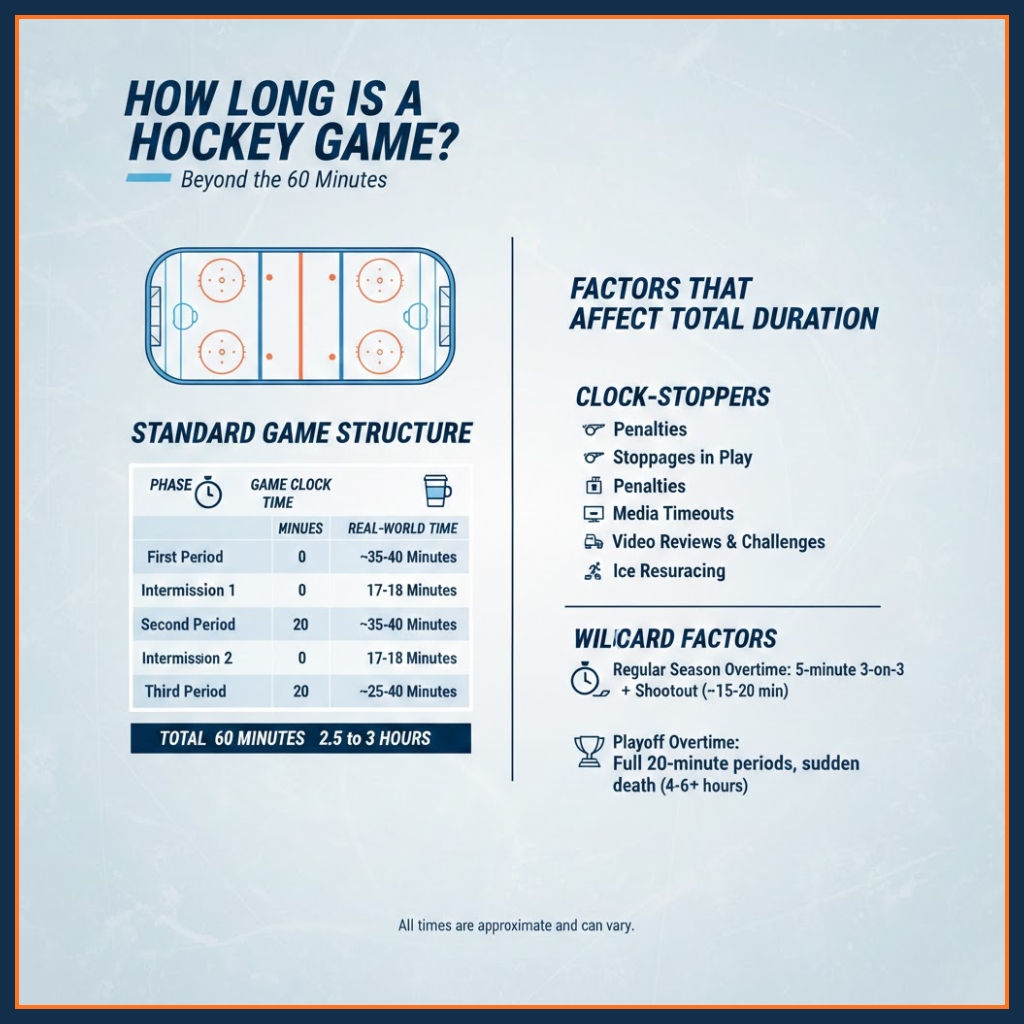
Hockey is a fast-paced, high-intensity sport, but one question often puzzles newcomers and casual fans alike: how long is a hockey game? Understanding the duration of a hockey match requires more than just knowing the total minutes on the clock.
The length can vary depending on the league, level of play, overtime rules, and even unexpected stoppages. In this guide, we’ll break down everything you need to know about hockey game duration—from regulation periods to playoffs, youth leagues, and international formats—so you can follow the game like a pro.
Understanding Hockey Game Structure
At its core, a hockey game is divided into periods, with breaks and potential overtime affecting the total runtime. Knowing the components of a game will help you grasp why actual matches often last longer than the standard game clock suggests.
Regulation Periods Explained
Most professional and competitive hockey leagues, including the NHL (National Hockey League), organize games into three periods, each lasting 20 minutes of play time.
| Component | Duration |
|---|---|
| 1st Period | 20 minutes |
| 2nd Period | 20 minutes |
| 3rd Period | 20 minutes |
| Intermissions | Two, 15–18 minutes each |
| Total Regulation | 60 minutes of play time |
While the game clock runs for 60 minutes, stoppages for penalties, goals, and reviews extend the real-time length. On average, a standard NHL game lasts about 2 hours and 30 minutes from start to finish.
Intermissions and Their Duration
After each period, players leave the ice for an intermission, typically 15–18 minutes long. During this time, the ice is resurfaced with a Zamboni, ensuring optimal conditions for the next period. Intermissions also give players a chance to rest and strategize, making them essential for maintaining game pace and quality.
Overtime, Shootouts, and Special Situations
Hockey games can extend beyond regulation if the score is tied. Overtime and shootouts are critical elements that impact total game duration.
NHL Overtime Rules
- Regular season: A 5-minute sudden death overtime with 3-on-3 skaters. The first team to score wins.
- Playoffs: Overtime consists of full 20-minute periods with standard 5-on-5 play, continuing until a goal is scored. This means playoff games can extend significantly, sometimes lasting over 3 hours.
Also read: How Long is a Football Game and What Affects Its Total Duration
Shootouts: Time and Procedure
If a regular-season game remains tied after overtime, a shootout determines the winner:
- Each team selects three players for penalty shots.
- The team with the most goals after these attempts wins.
- Additional rounds occur if necessary.
Shootouts are rare in playoff hockey, as games continue with sudden-death overtime instead.
Differences Across Leagues
Hockey game length isn’t universal. It varies by league, age group, and competition level.
NHL vs College Hockey Timing
- NHL: Three 20-minute periods, 15–18-minute intermissions, potential 5-minute overtime, shootouts.
- College hockey (NCAA): Three 20-minute periods, 15-minute intermissions, overtime varies by conference rules, often 5–10 minutes. Shootouts are sometimes used in regular-season games but not in playoffs.
International Hockey Game Duration
International hockey, governed by the IIHF (International Ice Hockey Federation), typically mirrors NHL timing:
- Three 20-minute periods
- 15-minute intermissions
- Overtime formats differ: sudden-death 5-on-5 for preliminary rounds; extended sudden death for playoffs
Youth and Amateur Hockey Rules
Youth leagues often shorten game duration to accommodate player stamina and skill levels:
- Under-12: 3 periods of 15 minutes each
- Teen leagues: 3 periods of 17–18 minutes
- Intermissions are typically 10–12 minutes
This ensures a manageable total game length while maintaining excitement.
Factors That Affect Total Game Length
Even with defined periods and intermissions, several factors can extend a hockey game beyond the scheduled runtime.
Stoppages and Timeouts
Hockey is a stop-clock sport, meaning the game clock pauses during:
- Goals and celebrations
- Icing calls
- Penalties and power plays
- Official reviews
Each stoppage can add several minutes, so while the regulation clock shows 60 minutes, real-time gameplay can last 2–3 hours.
Penalties and Power Plays
Penalties temporarily remove players from the ice, creating a power play situation. While the game clock continues, these interruptions influence strategy and can slow down play, indirectly extending overall game time.
Ice Resurfacing and Broadcast Delays
Televised games often experience delays for commercials, analysis, and ice resurfacing. The Zamboni process usually takes 10–12 minutes, adding to total runtime.
Comparing Hockey Game Duration to Other Sports
Understanding hockey’s timing is easier when compared to other sports:
| Sport | Regulation Length | Typical Real-Time Duration |
|---|---|---|
| Hockey (NHL) | 60 min | 2 hr 30 min |
| Soccer | 90 min | 2 hr |
| Basketball (NBA) | 48 min | 2 hr 15 min |
| American Football (NFL) | 60 min | 3 hr 15 min |
While hockey has a shorter regulation time than soccer or football, frequent stoppages and intermissions make it feel longer to spectators.
FAQs on Hockey Game Length
How long is a hockey game in real time?
Most NHL games last about 2 hours and 30 minutes, including intermissions and stoppages. Playoff games may extend over 3 hours.
Can hockey games end in ties?
Regular-season NHL games can no longer end in ties due to the 3-on-3 overtime and shootout rules. Historically, ties were possible before these rule changes.
Why do some games end faster than others?
Factors such as scoring frequency, penalties, injuries, and extended reviews influence the total game time. Games with few stoppages may conclude closer to 2 hours, while others with multiple delays can exceed 3 hours.
Do youth hockey games last as long as professional games?
No. Youth and amateur leagues shorten periods and intermissions to match player stamina and developmental needs.
How do overtime rules differ in playoffs?
In NHL playoffs, overtime is full 20-minute sudden-death periods, unlike the 5-minute regular-season overtime. Games continue until a goal is scored, leading to extended match durations.
Key Takeaways
- Standard regulation: 3 periods of 20 minutes each.
- Intermissions: Two breaks, 15–18 minutes each, add to total game length.
- Overtime: Varies by league; playoff overtime can last multiple periods.
- Shootouts: Used in regular-season NHL games to break ties.
- Youth and college games: Shorter periods and intermissions to suit players.
- Real-time game length: Typically 2–3 hours due to stoppages, penalties, and broadcasts.
- Comparative perspective: Hockey may feel longer than other sports despite shorter regulation time.
