

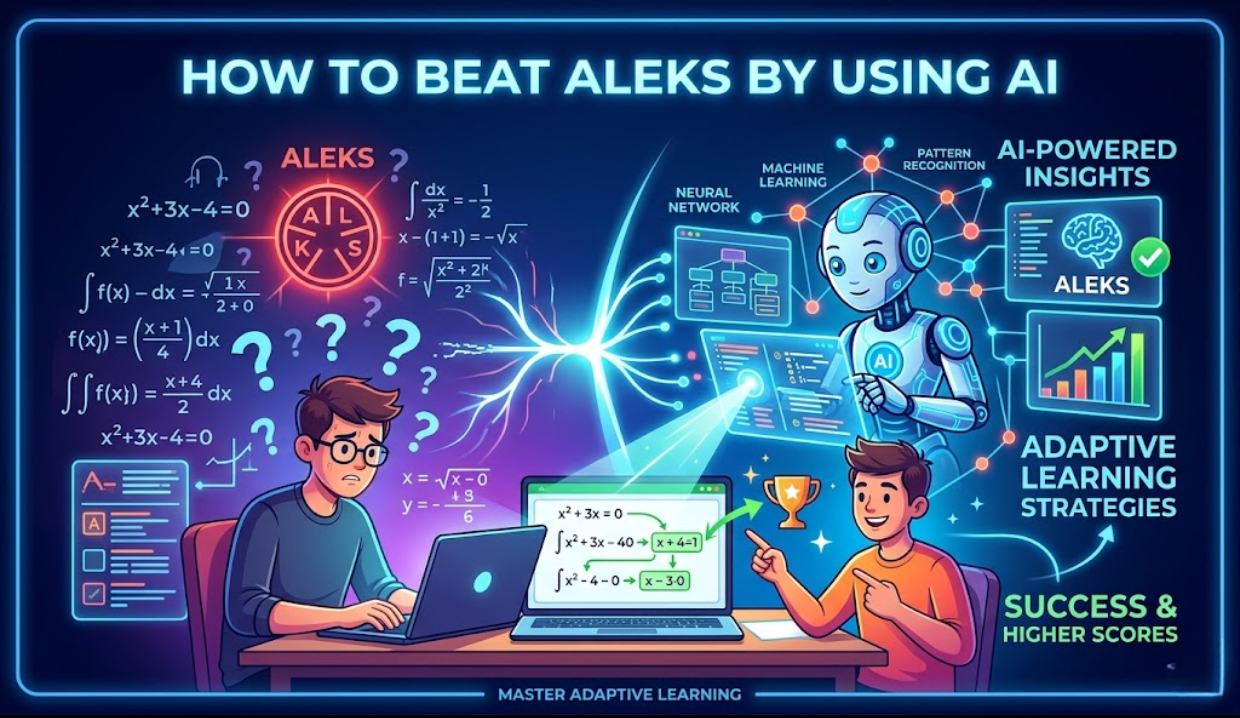
In today’s digital learning environment, platforms like ALEKS have transformed how students engage with subjects such as mathematics. ALEKS (Assessment and Learning in Knowledge Spaces) is an adaptive learning system that evaluates a student’s knowledge, identifies gaps, and customizes learning paths accordingly.
While ALEKS is highly effective, many learners seek ways to maximize their performance efficiently. One emerging approach is leveraging AI tools to enhance study efficiency, predict patterns, and optimize learning. This guide explores how AI can be applied to improve ALEKS mastery, without compromising understanding or academic integrity.
Understanding ALEKS and Its Adaptive Algorithm
How ALEKS Personalizes Learning
ALEKS uses adaptive learning algorithms to tailor course material to each student. When you start a topic, ALEKS assesses your current knowledge through a series of diagnostic questions. Based on your responses, it dynamically adjusts the difficulty and sequence of problems.
- Identifies mastery levels for each concept
- Offers targeted practice for weak areas
- Continuously updates learning paths as performance improves
This adaptive approach ensures that students spend more time on concepts they struggle with while skipping topics they have already mastered.
ALEKS Assessment Structure Explained
ALEKS operates on two primary functions: Knowledge Checks and Learning Modules.
- Knowledge Checks – These are brief assessments that determine your current understanding.
- Learning Modules – Based on your Knowledge Check results, ALEKS presents targeted exercises to build mastery.
Understanding this structure is key to applying AI effectively. By analyzing patterns in Knowledge Checks, AI tools can help focus practice more efficiently and predict problem types you may encounter next.
AI in Education: Transforming Adaptive Learning
How AI Predicts Answers and Patterns
Artificial intelligence uses algorithms and pattern recognition to understand large datasets. In the context of ALEKS, AI can:
- Analyze historical problem-solving patterns
- Identify common question types and structures
- Suggest efficient approaches to mastering specific topics
This predictive capability allows learners to focus on the most critical areas without redundant practice.
Tools That Can Enhance ALEKS Learning
Several AI-powered tools can complement ALEKS learning:
- GPT-based assistants – Provide step-by-step explanations and alternative problem-solving methods
- Wolfram Alpha – Solves complex math problems and demonstrates detailed calculations
- AI-driven practice generators – Create customized problem sets targeting weak knowledge areas
These tools do not replace learning but act as accelerators for comprehension and efficiency.
Step-by-Step AI Strategies to Optimize ALEKS
Applying AI effectively requires a structured approach. Here’s a step-by-step guide:
Also read: What Is Lobasincensura And How Does It Affect Online Speech
1. Assess Knowledge Gaps with AI Assistance
Before diving into modules, use AI to review foundational concepts. Ask AI assistants to explain topics where you historically struggle. This ensures that you enter ALEKS with a strong baseline.
2. Predict Problem Types
By analyzing prior ALEKS quizzes, AI can help identify patterns in question types. While you should not rely on AI to provide direct answers, understanding likely formats allows you to focus practice on areas that matter most.
3. Generate Customized Practice Problems
AI tools can produce practice questions tailored to your mastery level. For example:
| Topic | Practice Focus | AI Application |
|---|---|---|
| Algebra | Quadratic equations | AI-generated problem sets |
| Fractions | Simplification & conversion | Adaptive question generator |
| Geometry | Area & volume | Step-by-step AI hints |
This method enhances learning efficiency while reinforcing understanding.
4. Automate Mastery Tracking
AI can track your progress across ALEKS modules and provide predictive insights on your readiness for Knowledge Checks. Tools can visualize weak areas, simulate quizzes, and suggest optimal learning sequences.
5. Optimize Time Management
AI can recommend daily study targets based on your remaining topics and exam timelines. By balancing practice intensity and rest, you maximize retention without burnout.
Untapped AI Techniques Competitors Often Miss
Many learners overlook advanced AI strategies that can accelerate ALEKS mastery:
- Cognitive Load Reduction – AI can simplify complex problems into stepwise instructions, reducing mental fatigue.
- Adaptive Learning Loopholes – By analyzing ALEKS patterns, AI can help prioritize topics that unlock the most learning points.
- Exam Simulation AI – Simulates full Knowledge Checks to build familiarity with timing and question flow.
These methods improve efficiency without compromising genuine comprehension, ensuring that AI serves as a learning enhancer rather than a shortcut.
Ethical and Practical Considerations
While AI provides remarkable advantages, it is crucial to use it responsibly:
- Academic Integrity – Avoid using AI to generate direct answers for ALEKS assessments. Misuse may result in academic penalties.
- Learning Focus – Ensure AI enhances understanding rather than replacing effort. The goal is mastery, not just score improvement.
- Data Privacy – Use reputable AI tools and avoid sharing sensitive student data.
AI is most effective when used as a complement to active learning, providing explanations, practice optimization, and predictive insights.
Case Studies and Real-World Examples
Example 1: Algebra Mastery Acceleration
A student struggling with quadratic equations used an AI practice generator to supplement ALEKS exercises. By generating 50 targeted problems and tracking mastery predictions, the student reduced study time by 30% while achieving a 95% score on the next Knowledge Check.
Example 2: Time Management Optimization
Another student applied AI analytics to schedule learning sessions based on the difficulty of ALEKS modules. Predictive insights allowed them to focus on challenging topics during peak focus hours, improving retention and overall performance.
These examples demonstrate that AI integration can produce measurable improvements without compromising learning quality.
FAQS: How to Beat ALEKS by Using AI
Can AI predict ALEKS questions accurately?
AI can recognize patterns in question types and difficulty levels, helping you prioritize practice. However, it does not provide guaranteed answers.
Which AI tools work best for ALEKS assessments?
GPT-based assistants, Wolfram Alpha, and adaptive problem generators are effective for explanations, step-by-step guidance, and practice optimization.
How does ALEKS adapt to student responses?
ALEKS continuously evaluates mastery through Knowledge Checks, dynamically adjusting learning paths based on correct and incorrect answers.
Is it ethical to use AI with ALEKS?
Using AI to enhance understanding and practice is ethical. Generating direct assessment answers is considered cheating.
How can AI improve study efficiency for ALEKS?
AI helps by predicting weak areas, generating practice problems, visualizing progress, and optimizing study schedules.
Key Takeaways
- ALEKS is a powerful adaptive learning system, and AI can complement it to accelerate mastery.
- AI works best as a tool for prediction, practice generation, and progress tracking—not as a shortcut for answers.
- Stepwise strategies such as gap assessment, predictive problem identification, and AI-powered practice can reduce study time and improve retention.
- Ethical use of AI ensures long-term learning benefits and academic integrity.
- Combining AI insights with consistent practice transforms learning efficiency and helps achieve top ALEKS performance.
By integrating AI thoughtfully into your ALEKS study routine, you can maximize learning outcomes, save time, and achieve mastery across all topics. AI is not a replacement for effort—it is a smart guide that makes the learning process more focused, adaptive, and effective.
