

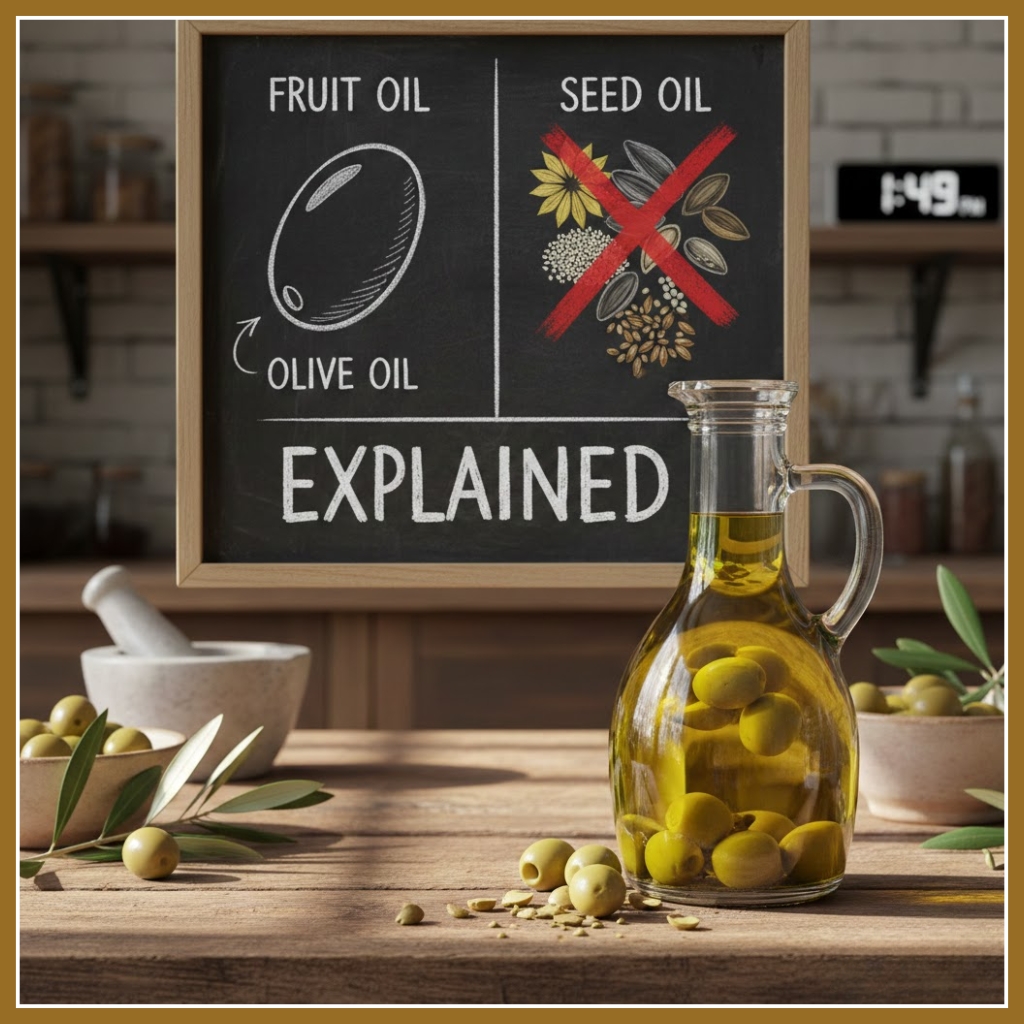
Confusion around seed oils has exploded online, and olive oil often gets dragged into the debate. Some sources lump it together with canola or soybean oil. Others insist it’s completely different. If you’ve ever wondered “is olive oil a seed oil?”, you’re not alone.
This article breaks it down properly—using botany, nutrition science, and processing methods—to give you a clear, accurate answer. No hype. No diet tribalism. Just facts, explained in a way that makes sense whether you’re new to nutrition or already deep into it.
The Short Answer (Featured Snippet Definition)
Olive oil is not a seed oil.
It is a fruit oil, extracted from the fleshy pulp of olives (the fruit of Olea europaea), not from seeds. Unlike industrial seed oils, olive oil is typically made through mechanical pressing without chemical solvents.
That distinction matters more than most people realize.
What Exactly Is a Seed Oil?
Before judging olive oil, we need a precise definition.
Scientific Definition of a Seed Oil
A seed oil is an oil extracted specifically from the seeds of plants. These oils are usually obtained from small, hard seeds that contain relatively little fat, requiring intensive processing to extract usable oil.
Common characteristics of seed oils:
- Oil comes from seeds, not fruit pulp
- Often require high heat and chemical solvents
- Typically refined, bleached, and deodorized
- Higher in polyunsaturated fats, especially omega-6
Common Examples of Seed Oils
- Canola oil
- Soybean oil
- Sunflower oil
- Corn oil
- Grapeseed oil
These oils dominate processed and packaged foods because they’re cheap, shelf-stable, and easy to mass-produce.
Also read: How Much Is Liposuction and What Factors Affect the Cost
Where Does Olive Oil Come From?
The Olive Is a Fruit, Not a Seed
Olives grow on olive trees (Olea europaea) and are classified botanically as drupes—the same category as peaches and cherries.
A drupe has three parts:
- Outer skin
- Fleshy pulp
- Inner pit (which contains the seed)
Olive oil comes from the fleshy pulp, not from the pit or seed inside.
That single fact alone disqualifies olive oil from being a seed oil.
Fruit Oil vs Seed Oil
| Feature | Olive Oil | Typical Seed Oil |
|---|---|---|
| Source | Fruit pulp | Seeds |
| Extraction | Mechanical pressing | Chemical + heat |
| Solvents needed | No | Usually yes |
| Fat profile | Mostly monounsaturated | High polyunsaturated |
| Traditional use | Thousands of years | Mostly modern |
Olive oil belongs in the same category as avocado oil, not canola or soybean oil.
How Olive Oil Is Made (Step by Step)
One of the biggest differences between olive oil and seed oils is processing.
Traditional Olive Oil Extraction Process
- Harvesting fresh olives
- Crushing whole olives (including pit) into a paste
- Malaxation (slow mixing to release oil droplets)
- Centrifugation to separate oil from water and solids
- Filtration (optional, depending on style)
That’s it.
No chemical solvents. No bleaching. No deodorizing.
How Seed Oils Are Typically Extracted
- Seeds are cleaned and crushed
- Heated at high temperatures
- Treated with chemical solvents (often hexane)
- Refined, bleached, and deodorized (RBD)
- Stabilized with additives
From a processing standpoint, olive oil and seed oils are worlds apart.
Extra Virgin Olive Oil vs Refined Olive Oil
Not all olive oil is equal, and this is where nuance matters.
Extra Virgin Olive Oil (EVOO)
- Cold pressed
- No chemical refining
- Retains polyphenols like oleocanthal
- Strong antioxidant activity
- Lowest oxidation risk
Refined Olive Oil
- Processed to remove defects
- Fewer antioxidants
- Still not a seed oil
- More neutral flavor
Even refined olive oil is not a seed oil, but extra virgin olive oil is the gold standard for health and nutrition.
Fatty Acid Profile: Olive Oil vs Seed Oils
Another reason olive oil gets confused with seed oils is fat content. Let’s compare.
Olive Oil Fat Composition
- ~70–75% oleic acid (monounsaturated fat)
- ~10% linoleic acid (omega-6)
- Low polyunsaturated fat overall
- High oxidative stability
Typical Seed Oil Profile
- High omega-6 linoleic acid
- Low monounsaturated fat
- More prone to oxidation
- Less stable when heated
Olive oil’s natural triglyceride balance is one reason it has been associated with better metabolic and cardiovascular outcomes in large population studies.
Does Olive Oil Cause Inflammation Like Seed Oils?
This is one of the most searched questions today.
The Omega-6 Myth Explained
Omega-6 fats are not inherently bad. Problems arise when:
- Intake is excessive
- Omega-6 heavily outweighs omega-3
- Oils are oxidized from processing or overheating
Olive oil:
- Contains relatively low omega-6
- Is rich in anti-inflammatory polyphenols
- Is resistant to oxidation
Compounds like oleocanthal act similarly to mild anti-inflammatory drugs, which is one reason olive oil is central to the Mediterranean diet.
Why Olive Oil Is Often Grouped With Seed Oils Online
This confusion usually comes from oversimplification.
Common Sources of Misinformation
- Social media diet trends
- Overgeneralized “seed oil free” lists
- Ignoring botanical definitions
- Confusing refined oils with raw sources
Some lists classify oils purely by being “plant-based,” which is nutritionally meaningless. Plants produce fruits, seeds, nuts, and roots—all very different biologically.
Is Olive Oil Allowed on Seed-Oil-Free Diets?
In most cases, yes.
Common Diet Perspectives
- Mediterranean diet: Olive oil is foundational
- Paleo-style diets: Generally allowed
- Ancestral nutrition: Often encouraged
- Seed-oil-free protocols: Usually permitted
The main concern in these diets is industrial processing, not plant origin. Olive oil doesn’t fit the industrial seed oil model.
Olive Oil vs Industrial Seed Oils: A Practical Comparison
| Criteria | Olive Oil | Industrial Seed Oils |
|---|---|---|
| Historical use | 5,000+ years | Mostly 20th century |
| Extraction | Mechanical | Chemical + heat |
| Omega-6 load | Moderate | Very high |
| Antioxidants | High (EVOO) | Minimal |
| Oxidation stability | High | Low |
| Whole-food origin | Yes | No |
From a real-world nutrition standpoint, olive oil behaves more like a whole food fat than a processed industrial ingredient.
Heating and Cooking: Is Olive Oil Stable?
Another misconception is that olive oil isn’t suitable for cooking.
Heat Stability Facts
- Smoke point of EVOO: ~375–410°F
- High antioxidant content protects against oxidation
- More stable than most seed oils when heated
Refined seed oils may have higher smoke points, but they oxidize more easily due to their fatty acid structure.
Regulatory and Scientific Classification
From an institutional standpoint:
- USDA categorizes olive oil separately from seed oils
- EFSA recognizes olive oil’s unique polyphenol content
- Botanical definitions clearly separate fruit oils from seed oils
There is no scientific authority that classifies olive oil as a seed oil.
Final Verdict: Is Olive Oil a Seed Oil?
No—by botany, processing, nutrition, and regulation, olive oil is not a seed oil.
It is:
- A fruit oil
- Extracted mechanically
- Low in omega-6 relative to seed oils
- Rich in monounsaturated fats and antioxidants
- Historically consumed as a whole-food fat
Lumping olive oil with industrial seed oils ignores fundamental biological and chemical differences.
Key Takeaways
- Olive oil comes from olive fruit pulp, not seeds
- Seed oils are extracted from seeds using industrial methods
- Olive oil’s fat profile and processing are fundamentally different
- Extra virgin olive oil offers anti-inflammatory compounds
- Most seed-oil-free diets allow olive oil for good reason
