

Sending money to one person is easy. Sending it to thousands across different countries, currencies, and payment systems is where things get complex. Businesses today—whether marketplaces, SaaS companies, or global enterprises—need reliable ways to handle bulk payouts without delays, high fees, or compliance risks.
This is where the top platforms for global mass payments come in. These systems are designed to automate, optimize, and scale cross-border disbursements while keeping costs and complexity under control.
This guide breaks down how these platforms work, what features matter, and how to choose the right one for your needs.
What Are Global Mass Payment Platforms?
Global mass payment platforms are systems that allow businesses to send money to multiple recipients across different countries in a single workflow. These platforms support multi-recipient payment gateways, automate payouts, and integrate with business systems through APIs.
In simple terms:
A global mass payment platform is a tool that helps companies send bulk payments—such as salaries, commissions, or vendor payments—quickly and efficiently worldwide.
Payouts vs Remittances vs Payment Processing
- Payouts: Business-to-many payments (e.g., paying freelancers or vendors)
- Remittances: Person-to-person international transfers
- Payment Processing (Pay-ins): Receiving payments from customers
Mass payment platforms focus specifically on outbound disbursement systems, not incoming payments.
How Global Mass Payment Systems Work
At a high level, these systems combine several layers:
- Payment orchestration layer – Routes payments through the most efficient channels
- Multi-currency disbursement engine – Handles currency conversion and FX optimization
- Local payout rails integration – Connects to regional systems like ACH, SEPA, or mobile wallets
- Compliance automation – Ensures KYC, AML, and regulatory checks
- API infrastructure – Enables automation and integration
Instead of relying on traditional wire transfers like SWIFT, modern platforms use localized payout methods to reduce cost and increase speed.
Key Features That Define Scalable Mass Payout Platforms
Multi-Currency & FX Optimization
Handling multiple currencies is not just about conversion—it’s about minimizing FX spreads and managing cross-border liquidity.
Look for:
- Real-time FX rates
- Transparent conversion fees
- FX hedging mechanisms
Also read: Who Are the Top Vendors for Large-Scale Application Modernization
Local Payment Rails Integration
The best platforms connect to local payout rails such as:
- Bank transfers (ACH, SEPA)
- Instant payment systems (FPS, UPI)
- Mobile money and e-wallets
This reduces dependency on SWIFT and lowers transaction costs.
API Automation & Webhooks
Modern systems rely heavily on mass payment APIs and webhook-based payout tracking.
Benefits include:
- Automated bulk payment processing
- Real-time notifications
- Seamless integration into SaaS platforms
Compliance (KYC, AML, Tax Handling)
Cross-border payouts require strict compliance. Advanced platforms offer:
- Automated identity verification
- Sanctions screening
- Tax form management
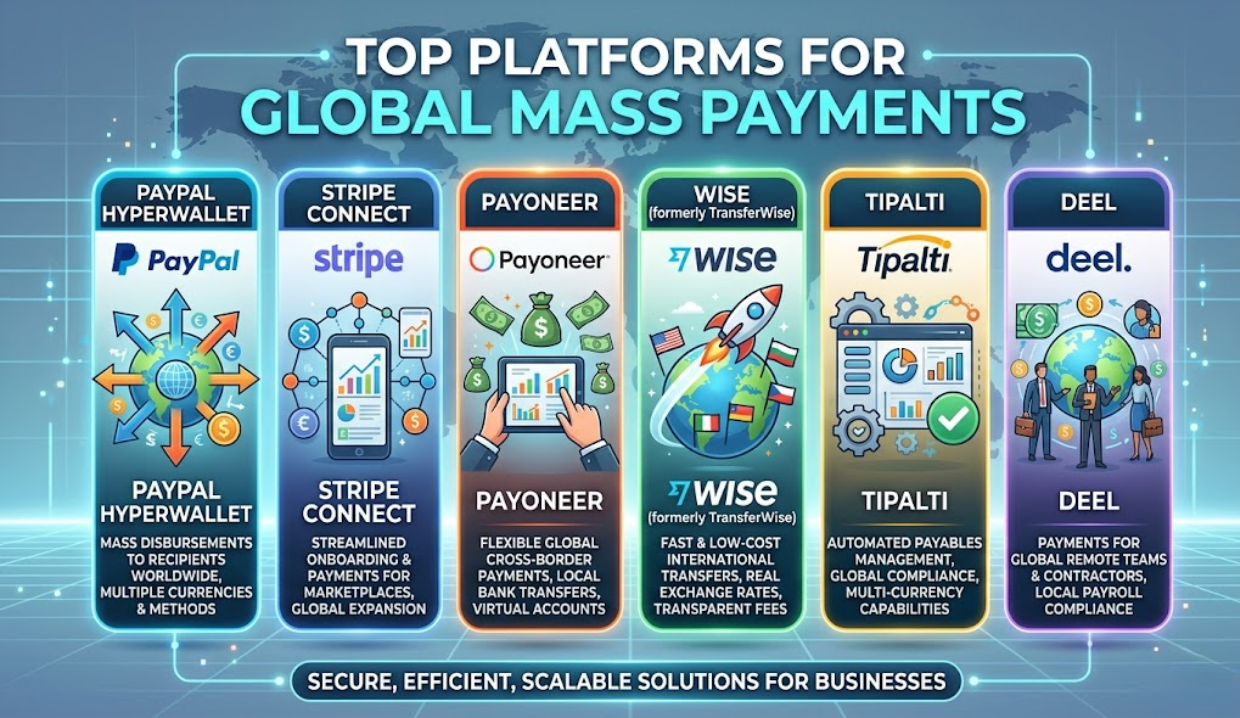
Top Platforms for Global Mass Payments
Several providers dominate the global payout ecosystem, each with unique strengths.
- Stripe – Strong API-first approach and embedded finance capabilities
- PayPal – Widely used with mass payout features for marketplaces
- Wise – Known for transparent FX and low-cost international transfers
- Payoneer – Popular for freelancer and affiliate payouts
- Airwallex – Offers global payment routing and multi-currency accounts
- Rapyd – Focuses on local payment method coverage
- Adyen – Enterprise-grade platform with strong global infrastructure
- Hyperwallet – Specialized in payout infrastructure for platforms
- Tipalti – Designed for automated supplier payments
Comparison Snapshot
| Feature | API Strength | FX Transparency | Global Coverage | Best For |
|---|---|---|---|---|
| Stripe | High | Medium | Strong | SaaS & marketplaces |
| PayPal | Medium | Low | Very strong | General use |
| Wise | Medium | High | Strong | Cost-sensitive payouts |
| Payoneer | Medium | Medium | Strong | Freelancers |
| Airwallex | High | Medium | Growing | Startups & scaling firms |
Architecture of Global Payout Systems
Payment Orchestration Layers
A payment orchestration platform acts as a control layer that:
- Routes payments dynamically
- Chooses the cheapest or fastest provider
- Reduces dependency on a single vendor
This is critical for scalability and redundancy.
Treasury & Liquidity Management
Global payouts require careful handling of funds:
- Prefunding accounts in multiple currencies
- Managing liquidity across regions
- Using just-in-time funding models
Real-Time vs Batch Processing
- Batch processing: Lower cost, slower settlement
- Real-time payout rails: Instant transfers but higher fees
Choosing between them depends on the use case and urgency.
How to Choose the Right Platform
For Marketplaces & Gig Platforms
Focus on:
- Automated freelancer payouts
- Multi-currency wallet infrastructure
- High transaction scalability
For SaaS & Embedded Finance
Look for:
- API-first platforms
- Embedded payout tools
- Webhook-based automation
For Enterprise Vendor Payments
Prioritize:
- Compliance automation
- Bulk supplier payments
- Advanced reporting and reconciliation
Hidden Costs & Optimization Strategies
FX Spread Minimization
Many platforms advertise low fees but hide costs in FX spreads.
To optimize:
- Compare real exchange rates
- Use platforms with transparent pricing
- Batch similar currency payouts
Avoiding SWIFT Fees
Traditional SWIFT transfers are expensive and slow.
Instead:
- Use local payout rails
- Leverage regional payment systems
- Optimize payout corridors
Payment Routing Optimization
Advanced platforms use smart payment routing to:
- Reduce transaction failures
- Lower costs
- Improve speed
Compliance, Security & Risk Management
Global payouts come with regulatory challenges.
Key Compliance Requirements
- KYC (Know Your Customer)
- AML (Anti-Money Laundering)
- Sanctions screening
Fraud Detection in Bulk Payments
Modern systems include:
- AI-based fraud detection
- Transaction monitoring
- Risk scoring
Data Protection Standards
Look for:
- Encryption protocols
- Secure APIs
- Compliance with global standards
Advanced Strategies Most Competitors Miss
Payout Orchestration vs Single Provider
Relying on one provider is risky.
A better approach:
- Use multiple payout providers
- Implement redundancy strategies
- Enable failover systems
Payout Retry Logic & Failure Handling
Failed transactions are inevitable.
Advanced systems:
- Automatically retry failed payments
- Use alternative routing
- Provide detailed error reporting
Liquidity Models
Two main approaches:
- Prefunding: Faster but capital-intensive
- Just-in-time funding: More flexible but complex
Developer Layer: APIs & Integration
REST APIs for Mass Payments
Developers can:
- Automate bulk payments
- Schedule disbursements
- Integrate with ERP systems
Webhooks & Real-Time Tracking
Webhooks enable:
- Instant status updates
- Event-driven workflows
- Better payment visibility
Sandbox Environments
Before going live:
- Test payout flows
- Simulate edge cases
- Validate integrations
FAQS: Top Platforms for Global Mass Payments
What is the best platform for global mass payouts for startups?
Startups typically benefit from API-first platforms with flexible pricing and strong automation. Platforms with embedded finance capabilities are ideal for scaling quickly.
How do businesses send bulk international payments efficiently?
They use batch payment processing platforms combined with local payout rails and automated APIs to reduce cost and improve speed.
How do global payout systems handle currency conversion?
They rely on multi-currency disbursement engines that convert funds using real-time FX rates and optimized routing strategies.
What are the cheapest ways to send bulk payments worldwide?
The most cost-effective approach is:
Use local payout methods instead of SWIFT
Optimize FX conversion
Batch payments where possible
How to automate global vendor payments at scale?
Use a platform that offers:
API-driven automation
Compliance workflows
Payment scheduling and reconciliation
Future Trends in Global Mass Payments
Real-Time Cross-Border Payments
Instant payment systems are expanding globally, reducing reliance on delayed settlement models.
Embedded Finance Expansion
More platforms are integrating payouts directly into their products, enabling seamless financial experiences.
Blockchain & Alternative Rails
Emerging technologies aim to:
- Reduce costs
- Improve transparency
- Enable faster settlement
Final Verdict: Choosing the Right Platform
There is no one-size-fits-all solution when it comes to the top platforms for global mass payments. The right choice depends on your business model, scale, and operational needs.
Key takeaways:
- Use platforms with strong API automation and local payout integration
- Optimize costs through FX management and smart routing
- Prioritize compliance and security from day one
- Consider orchestration layers for scalability and redundancy
Businesses that treat payouts as a strategic function—not just an operational task—gain a clear advantage. They move faster, reduce costs, and deliver a better experience to partners, vendors, and users worldwide.
