

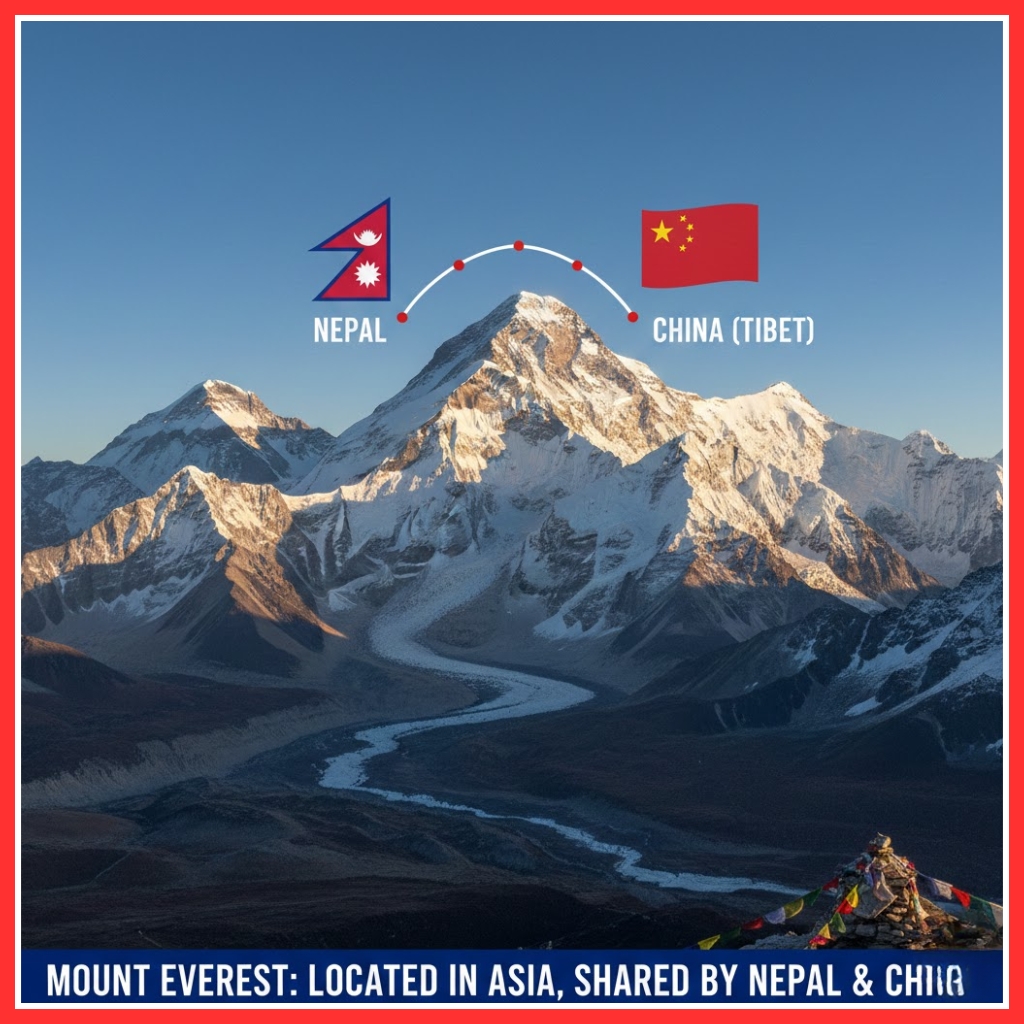
Mount Everest, the world’s tallest mountain, has captivated explorers, climbers, and travelers for centuries. Rising to an astounding 8,848.86 meters (29,031.7 feet) above sea level, it is not just a natural landmark but a symbol of human endurance and the majesty of the Himalayas.
But where exactly is Mount Everest in Asia, and what makes its location so significant? This guide provides a comprehensive answer, combining geography, history, trekking routes, and cultural context for both beginners and advanced readers.
Mount Everest: Overview of Asia’s Highest Peak
Mount Everest, also known as Sagarmatha in Nepal and Chomolungma in Tibet, sits at the intersection of two remarkable regions: the Khumbu region of Nepal and the Tibetan Plateau of China. It is part of the Himalayan mountain range, which spans several Asian countries, including Nepal, China, India, Bhutan, and Pakistan.
Everest Elevation and Coordinates
- Elevation: 8,848.86 meters (29,031.7 feet)
- Latitude: 27.9881° N
- Longitude: 86.9250° E
- Mountain Range: Himalayas
- Countries: Nepal (south) and China/Tibet (north)
The mountain’s precise coordinates allow climbers and geographers to locate it accurately on maps and GPS systems. These coordinates also define international borders between Nepal and China, making Everest geopolitically significant as well.
Countries Sharing Mount Everest
Mount Everest straddles two countries, each offering distinct approaches for climbers and trekkers.
Nepal: Khumbu Region and Sagarmatha National Park
The southern face of Everest is located in Nepal’s Khumbu region, home to the Sagarmatha National Park, a UNESCO World Heritage Site. This area is characterized by dramatic valleys, glaciers, and Sherpa villages. The south route, commonly used by climbers, begins at Everest Base Camp in Nepal, which sits at an altitude of 5,364 meters (17,598 feet).
Key highlights in Nepal include:
- Khumbu Icefall: A treacherous glacier route early in the ascent.
- Namche Bazaar: The main hub for trekking supplies and acclimatization.
- Sherpa Villages: Rich cultural heritage and traditional mountain lifestyles.
Also read: Where in the US is New England, and What States Does It Include
Tibet: Northern Slope and Tibetan Plateau
The northern face lies in the Tibetan Autonomous Region of China, offering a different climbing route. The north base camp, at around 5,150 meters (16,900 feet), provides easier access by vehicle compared to Nepal. Climbers must navigate:
- Rongbuk Glacier: A crucial part of the northern climbing route.
- Tibetan Plateau: Known as the “Roof of the World,” it influences Everest’s climate and weather patterns.
The dual-country location also leads to variations in climbing regulations, permits, and environmental management strategies.
Mapping Mount Everest
GPS Coordinates and Satellite View
Mount Everest can be precisely mapped using modern GPS technology. Satellite imagery reveals its position in the eastern Himalayas, bordered by Nepal to the south and Tibet to the north. Understanding its coordinates is critical for navigation, trekking, and research purposes.
Nearby Towns, Valleys, and Rivers
- Lukla (Nepal): Starting point for south route treks.
- Dingboche and Lobuche: Acclimatization villages.
- Kangshung Valley (Tibet): Less-visited, remote approach to Everest.
- Dudh Kosi River: Originates in the Khumbu region, fed by glaciers.
Maps and satellite views also illustrate surrounding peaks like Lhotse (8,516 meters) and Nuptse (7,861 meters), which define Everest’s dramatic skyline.
Trekking and Climbing Routes
South Route via Nepal
The southern route is the most popular path to Everest’s summit. Steps include:
- Fly to Lukla and trek to Namche Bazaar.
- Continue to Tengboche Monastery for acclimatization.
- Reach Everest Base Camp via Dingboche and Lobuche.
- Ascend through Khumbu Icefall, Western Cwm, and South Col.
- Summit via the Southeast Ridge.
North Route via Tibet
The northern route is technically easier to access by vehicle but presents harsher weather. Steps include:
- Drive to Rongbuk Monastery and North Base Camp.
- Trek along the Rongbuk Glacier.
- Ascend via the North Col and northeast ridge.
- Reach the summit, returning via the same path.
Both routes require careful planning, permits, and acclimatization strategies to avoid altitude sickness.
Geological and Environmental Insights
Himalayan Formation and Tectonic Plates
Everest was formed over 60 million years ago due to the collision of the Indian and Eurasian tectonic plates. This ongoing process pushes the Himalayas upward by approximately 5 millimeters per year, contributing to Everest’s gradual growth.
Climate Zones and Ecosystem
The mountain spans multiple climate zones:
- Lower slopes: Temperate forests and alpine vegetation.
- Higher elevations: Sparse vegetation, glaciers, and permanent snow.
- Summit: Extreme cold, high winds, and low oxygen levels.
Flora includes rhododendrons and junipers, while fauna features snow leopards, Himalayan tahr, and yaks at higher altitudes.
Cultural and Historical Significance
Everest holds deep cultural importance for both Nepalese and Tibetan communities.
- Sherpa Communities: Known for guiding climbers and maintaining trail infrastructure.
- Tibetan Traditions: Revered as Chomolungma, “Goddess Mother of the World.”
- Historical Expeditions: First confirmed summit by Sir Edmund Hillary and Tenzing Norgay in 1953.
- Religious Sites: Monasteries and prayer flags dot the trekking routes, reflecting spiritual traditions.
The mountain’s influence extends beyond climbing, inspiring art, literature, and environmental conservation efforts.
Practical Information for Visitors
Base Camps and Trekking Permits
- Nepal: Trekking permits required, regulated by the Nepal Mountaineering Association.
- Tibet: Permits issued by the Chinese authorities; vehicle access to the north base camp simplifies logistics.
- Best Seasons: Pre-monsoon (April–May) and post-monsoon (September–October).
Safety, Altitude, and Weather Considerations
- Altitude Sickness: Gradual acclimatization is crucial.
- Weather Patterns: Sudden storms and extreme cold are common.
- Equipment: Oxygen cylinders, crampons, and insulated clothing are essential.
Hidden Facts About Everest
Many aspects of Everest remain less explored:
- Remote Observation Points: The Kangshung Face offers a less-traveled perspective.
- Trekking Microclimates: South and north routes experience distinct weather patterns.
- Glacial Changes: Melting glaciers reveal new trekking paths and archaeological discoveries.
- Border Disputes: Slight variations in surveys have geopolitical implications.
These untapped insights provide opportunities for unique exploration and research beyond standard climbing narratives.
FAQS About where is mount everest in asia
Where exactly is Mount Everest located in Asia?
Mount Everest is located in the eastern Himalayas, on the border between Nepal (south) and Tibet, China (north), with coordinates 27.9881° N, 86.9250° E.
Which countries share Mount Everest?
Nepal and China (Tibet Autonomous Region) share Mount Everest.
What is the easiest route to Everest Base Camp?
From Nepal, the south route via Lukla is the most common, while Tibet offers road access to the north base camp.
What are the nearby valleys and rivers?
The Khumbu Valley in Nepal and the Kangshung Valley in Tibet are notable, with rivers like the Dudh Kosi originating from glaciers.
Conclusion: Key Takeaways
Mount Everest is more than just Asia’s highest peak—it is a convergence of geography, culture, and history. Its exact location on the Nepal-Tibet border makes it a unique natural landmark, offering diverse trekking routes, rich ecosystems, and profound spiritual significance.
Understanding Everest requires knowledge of:
- Its geographical coordinates and surrounding regions.
- Climbing routes, base camps, and practical logistics.
- Geological and climatic factors shaping the Himalayas.
- The cultural and historical context of local communities.
